Research
Becoming a fellow at UT Southwestern Medical Center means you become a part of one of the largest communities of research in the area. UT Southwestern provides immense opportunities for critical care fellows to develop their academic careers alongside faculty members dedicated to improving the lives of their patients and community.
In addition to clinical care, the Division of Pediatric Critical Care Medicine is involved in basic science research, sponsored clinical trials, and clinical translational research, as well as national collaborative studies. The division maintains a high profile at regional, national, and international meetings, with numerous presentations and invited lectures given by faculty and fellows. Faculty within the division are involved in a variety of research endeavors, including bench, translational, and clinical research projects. Other faculty members engage in educational scholarship and quality improvement efforts.
Fellows spend approximately half of their time in fellowship engaging in scholarly activity, and the amount of research time for fellows increases each year, as described in the rotation breakdown. At the outset of training, fellows meet with program leadership, as well as their individual faculty mentors, with the goal of aiding fellows in identifying a project and research mentor early in their fellowship.
Sam Davila, our Associate Program Director and Scholarly Oversight Committee Chair discusses fellowship research.Michelle Mizrahi Yaffe, PGY 5, and Maja Stanojevic, PGY 6, discuss fellowship research.Lakshmi Raman, former Medical Director of ECMO and member of the ELSO steering committee, discusses her research and her experiences mentoring critical care fellows.Explore a different pathway to fellowship research
Meredith DeCoy, Will Lester and Sierra Foster (current and recent fellow) discuss their research experience at UTSW
Erin Tresselt, recent fellowship graduate and current faculty member, also discusses her research experience.
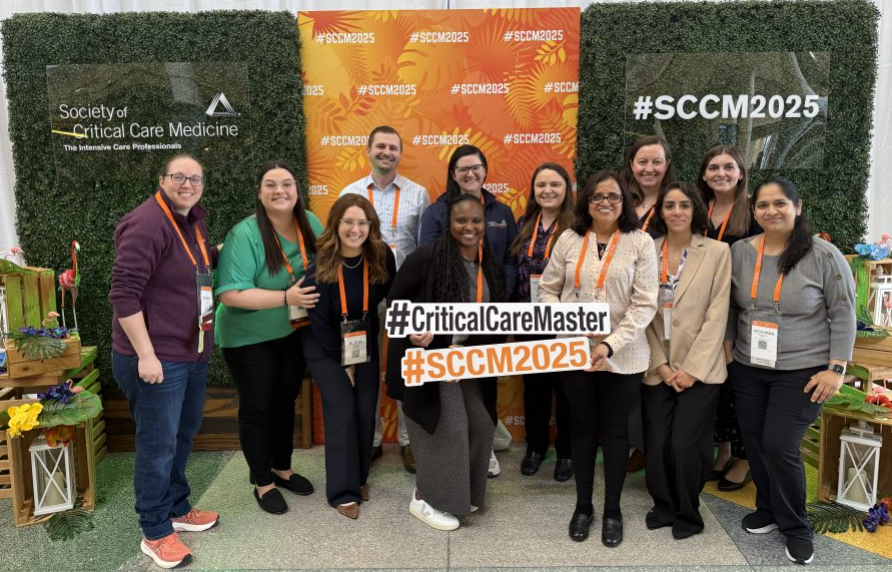
National Fellow Research Prescence
In our most recent academic year, we were honored to have ten fellow presentations at national meetings, including: ELSO, PCICS, SCCM, and PAS.
Fellows pursue a variety of paths in research, including laboratory-based projects, clinical research, and simulation.
Protected Time for Research
Fellows have an average of 17 months of protected time, excluding vacation.
The amount of time increases from the first to the third year and is clustered to enhance productivity.
Recent Basic Science Projects
The role of stem cells in neurogenesis after trauma
The impact of hypoxia on brain development and function
The interaction between endothelial and alveolar cells in various mechanisms of lung injury
Signal transduction pathways in the pathogenesis of sepsis and burn injury
Metabolic effects of sepsis in the pig model
Recent Division Clinical Studies
Collaborative projects with the NIH-funded Therapeutic Hypothermia for Cardiac Arrest Research Network, consisting of six other institutions in North America
Collaborative participation on the NIH-funded RESTORE study on the use of a sedation protocol for critically ill children, involving 21 institutions in North America
Collaborative studies with PALISI pediatric critical care network
Effect of gentamicin on hypocalcemia in the newborn
Recent Translational Studies
Immunological phenotype of severe sepsis, SIRS, MODS, and HLH
Clinical projects in the Division of Pediatric Critical Care are aided by comprehensive databases maintained in areas of the Division’s activities including cardiopulmonary resuscitation, ECMO, head trauma, and medical emergency team (MET). In addition, fellows have access to other resources within the larger UT Southwestern community, including the Perot Brain and Nerve Injury Center, the Maternal Fetal Medicine Network, and the Pediatric Pharmacology Research Units (PPRU) networks.
Our program is closely integrated with the Departments of Biochemistry, Clinical Nutrition, Pulmonary Vascular Biology, Pharmacology, Physiology, Cell Biology, and Neuroscience, making research opportunities available outside of the Division.
Mentored Research Projects and Scholarship
Each fellow is expected to complete a research project under the guidance and with the help of a mentor and a scholarship oversight committee.
Each fellow is encouraged to select a research project that best meets her or his own interests and career plans. This project is expected to lead to presentation of one or more abstracts at national meetings and publication of a manuscript in a peer-reviewed journal.
Scholarship may also include chapters, state-of-the-art reviews, and case reports.
Second- and third-year fellows attend the national meetings of the Society of Critical Care Medicine, American Thoracic Society, and Pediatric Academy Societies (PAS).
Each graduate should complete and publish at least one manuscript arising from their research endeavors.
Specialized Research Training Opportunities
The Clinical and Translational Science Award (CTSA) Program is an excellent resource in research project planning and implementation. The Program also offers advanced training opportunities, including a Master of Science in Clinical Science, Graduate Certificate in Clinical Science, and Master of Science in Health Informatics. Finally the new Peter O-Donnell Jr. School of Public Health welcomed its first class in 2023.
External and Internal Funding Opportunities
Fellows in the Pediatric Critical Care Fellowship are eligible for several external sources of funding from the American Academy of Pediatrics, NIH, and several other national organizations and foundations.
UT Southwestern offers a Physician Scientist Training Program (PSTP), which provides three years of salary and allows highly individualized research training and career development. Additional sources of funding include Children’s Medical Center and the Department of Clinical Sciences.
UT Southwestern offers opportunities for T-32 Grants in Genetics, Cell & Molecular Biology Training Program, Gastroenterology and Hepatology Research, Basic Science of Drug Abuse, Cardiovascular Research, Renal Control of Body Composition and Blood Pressure, Cellular Biophysics of Neuron, Endocrine and Metabolism, Infectious Diseases, Mechanisms of Drug Action and Disposition, Molecular Microbiology, Trauma, Inflammation and Sepsis, and Interdisciplinary Research Training (Physiology).
Ongoing and Recent Fellow Research Projects:
Evaluating Pediatric Critical Care Needs and Capacity in Resource-Limited Settings: A Multi-Institutional Survey Study in Developing Nations - Ongoing
Optic Nerve Sheath Diameter as a Predictor of Intracranial Pressure in POst-Cardiac Arrest Patients: A Prospective Description Study - Ongoing
Evaluating Pediatric Critical Care Needs and Capacity in Resource-Limited Settings: A Multi-Institutional Survey Study in Developing Nations
Impact of Sedation Strategies on Mechanical Complications in Pediatric ECMO: A Retrospective Study - Ongoing
Implementation of Structured Nurse-Led Rounds in the Pediatric Intensive Care Unit to Improve Clinical Communication Effifiency and Efficacy - Ongoing
Identifying Changing Trends in Bronchiolitis Patients Admitted to the Pediatric ICU - Ongoing
Qualitative Perspectives of Pediatric ECMO and Moral Distress - Ongoing
Improved Outcomes Among Patients <5kg Supported by cfVAD - Ongoing
Medical Education Development for Pediatric Subspecialty Fellows - Ongoing
Beyond CPR Quality: Evaluating the Impact of a Teamwork-Focused CPR Coach Using Validated Team Performance Metrics - Ongoing
The Use of Quantitative Electroencephalography to Predict Neurologic Outcomes Following Pediatric In-Hospital Cardiac Arrest - Graduated
Implementation of standardized multidisciplinary communication prior to intrahospital transport of critically ill pediatric patients: a quality improvement initiative-Graduated
Neuroimaging and neurological outcomes in pediatric patients with congenital heart disease post cardiopulmonary bypass and ECMO - Graduated
The Effect of Hyperoxia on Neurologic Outcomes in Pediatric Venoarterial Extracorporeal Membrane Oxygenation - Graduated
Implementation of Clinical Provider Ultrasound Guided IV Placement in Pediatric Intensive Care Units - Graduated
Evaluating Outcomes and Complications of Continuous Renal Replacement Therapy: The Children's Dallas experience - Graduated
Exploring Pediatric ECMO Candidacy: A Qualitative Approach - Graduated
Implementation of a Sedation and Analgesia Weaning Protocol Compared with Non-protocolized Weaning in Critically Ill Mechanically Ventilated PICU Patients-Graduated
Automated pupillometry for prediction of neurologic outcomes in children requiring extracorporeal membrane oxygenation (ECMO) - Graduated
Early EEG to predict severity of injury in infants with abusive traumatic brain injury - Graduated
National Trends in Critical Asthma Severity During the Covid-19 Pandemic - Graduated
Implementation of a Rounding Checklist in the Pediatric Cardiac Intensive Care Unit - Graduated
Implementation of Fluid Overload Prevention Initiative in Pediatric Intensive Care Unit - Graduated
Hyperthermia After Ischemic and Traumatic Brain Injury in Children: Frequency and Duration of Hyperthermia and Effect on Neurologic Outcomes - Graduated
Validation of venous excess ultrasound in pediatrics: A feasibility study - Graduated
Decompressive Craniectomy following Pediatric Stroke: An Institutional Analysis - Graduated
Implementations of a Protocol for Neonatal ECMO Anticoagulation to Transition to Utilization of TEG Data: A Quality Improvement Project - Graduated
Predicting Neurologic Injury in Children Requiring Extracorporeal Membrane Oxygenation (ECMO) by Identifying Disruptions in Cerebral Autoregulation - Graduated
PICU Toxic Ingestion Severity Scoring During the COVID-19 Pandemic - Graduated
Effect of a Clinical Case Narrative on Podcast Knowledge Acquisition and Retention: A Randomized Controlled Trial - Graduated
Outcomes of Pediatric Hematology and Oncology Patients on Extracorporeal Membrane Oxygenation - from the HOPPE (Hematology Oncology Pediatric Patients on ECMO) Study Group - Graduated
Evaluating Nutritional Rehabilitation and Outcomes of Children Supported with Ventricular Assist Device as a Bridge to Heart Transplantation - Graduated